Irish Road Signs and Road Markings
19 signs and markings, each with what it requires of you and the mistakes that cost marks on the practical driving test. Wording is ours; the rules come from the Road Safety Authority's Rules of the Road.
Regulatory signs
These tell you what you must or must not do. Ignoring one is a fault in its own right.
 Stop sign: A STOP sign requires a full stop. After stopping, check that it is safe to proceed.
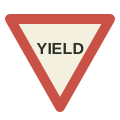 Yield sign: Yield to traffic with priority. A full stop may be needed, but is not required when you can safely give way without stopping.
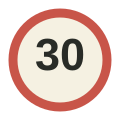 30 km/h limit sign: A posted speed limit is a maximum, not a target. Slow further for conditions. This example does not state a speed limit for any real road.
 Keep left sign: The arrow directs you to pass on the left side of the obstruction or island.
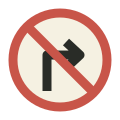 No right turn sign: The crossed right-turn arrow prohibits a right turn. Choose a permitted route instead.
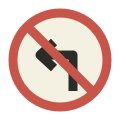 No left turn sign: The sign prohibits the illustrated turn. Check the junction’s remaining signs and markings for the permitted route.
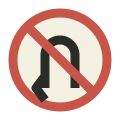 No U-turn sign: A red ring forbids what the sign shows, whatever the traffic is doing. Here it is turning to face back the way you came.
Warning signs
These tell you what is coming. They are the cue to slow down and start looking, not to brake late.
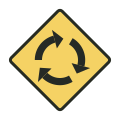 Roundabout ahead sign: Irish warning signs use a yellow diamond. This sign warns of a roundabout; look for lane signs, markings and circulating traffic.
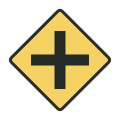 Crossroads ahead sign: A crossroads warning highlights a junction ahead. It does not by itself determine priority.
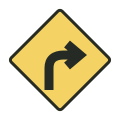 Dangerous bend ahead sign: Plan your approach so that you can negotiate the bend within the distance you can see to be clear.
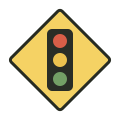 Traffic signals ahead sign: Expect traffic signals ahead. Look beyond the nearest vehicle and be ready to slow down or stop.
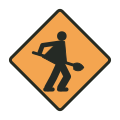 Roadworks ahead sign: Temporary roadworks warnings have an orange background. Expect workers, changed lanes, machinery and temporary signals.
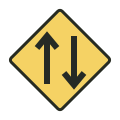 Two-way traffic sign: Prepare for opposing traffic, particularly when leaving a one-way section or divided road.
Road markings
Paint carries rules too. Lines and boxes decide where you may drive, stop and wait.
 Continuous white centre line: Keep left of continuous centre lines. The Road Safety Authority identifies exceptions for an emergency or access; they are not permission for ordinary overtaking.
 Broken white centre line: A broken centre line may be crossed when safe. You must still assess visibility, traffic, junctions and other restrictions.
 Yellow box junction: Do not enter for a straight-ahead movement without enough exit space. A limited exception exists for some right turns.
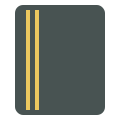 Double yellow lines: Double continuous yellow lines along the road edge prohibit parking at any time. Separate rules cover stopping and loading.
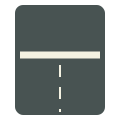 Stop line: At a red signal you must not pass the stop line. Keep the space beyond it clear.
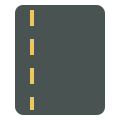 Broken yellow edge line: A broken yellow edge line indicates a hard shoulder. Ordinary roads and motorways have different rules for its use.